
You just paid good money for a new moving lead. The notification came while you were driving to a job, so you made a decision to call them in a few hours when you will have a quiet moment to give them your full attention. In reality, you just handed that job to your competitor.
In the moving industry, a customer isn’t won on the day of the move. That is done in the first few minutes after they ask for a quote. Movers often complain about bad leads, but often, the lead wasn’t bad, the timing was just too slow. This article explores why the clock can be your biggest enemy, but also your greatest ally when it comes to closing leads.
Why Focusing Only On Hard Work Is a Bad Decision
We are going to look at the data, but before we do that, we need to address the mindset issue a lot of movers have. Moving company owners are hard workers, they take pride in the physical aspect of the job, ensuring the furniture is wrapped perfectly and the truck is packed tight. However, focusing only on that part of the job is exactly what loses them money.
Many movers feel that stepping away from a move to briefly answer a call is slacking off. But not answering that call may cost you the next job, and that’s why it’s important to pick it up. You might think: “If they need to move, they will call again later”, but that thinking will cost you thousands of dollars every month, because if you don’t pick up the phone, 5 minutes later they are speaking with your competitor and arranging their move.
The “Golden Window” is Smaller Than You Think
A lot of research has been done, trying to understand what is the optimal time window for responding to a lead. The most thorough one, published in Harvard Business Review, states that the golden window for answering and qualifying a lead is no more than 5 minutes. In fact, the odds of qualifying a lead after 10 minutes decrease by a stunning 400%, when compared to 5-minute window. Let that sink in.
And the chances are not getting any better as the time passes. Why is the drop-off so steep? Because with every intent-heavy purchase, and moving is one of those – the customer is focused on getting the information as soon as possible. They are looking at their screen, searching for the best solution. That’s why you want to get to them as soon as possible and grab their focus. Ten minutes after they filled the quote form, the baby is crying, they are driving to work, or worst case scenario, they are closing the deal with other company that called them 2 minutes ago. If you are not inside that 5-minute window, you aren’t just late, you are invisible.

People Expect Quick Response
We often hear movers saying how they don’t want to seem desperate by calling too fast. Let’s end that myth right now. When it comes to online marketing, calling fast doesn’t look desperate, it looks competent.
Your customers live in a world where they press a button, and a car shows up, food arrives and a package they ordered is on their porch the next day. The same way, when they press “Get a quote” button, they have a subconscious expectation of an immediate reaction. Quick reaction within five minutes instantly signals that you are well organized and professional.
First Response Beats “Perfect” Response
Many moving company owners hesitate to call right away because they are in the middle of something. Maybe they are driving, don’t have a pen ready or can’t provide precise quote right away. But it’s important to call, nevertheless.
The goal of the first call is not to give a binding estimate, but to stop the shopping process. When the lead comes in, the customer is likely on a lead platform (like Angi). They filled out your form and now they are looking at the next company on the list. If you don’t grab their attention, they will fill out the next form. But if you call right away, you are “claiming” that lead. Maybe you can’t provide the precise quote right away, but they are talking to a human for the first time in their search for a moving company.
The Math of Missed Opportunities (ROI)
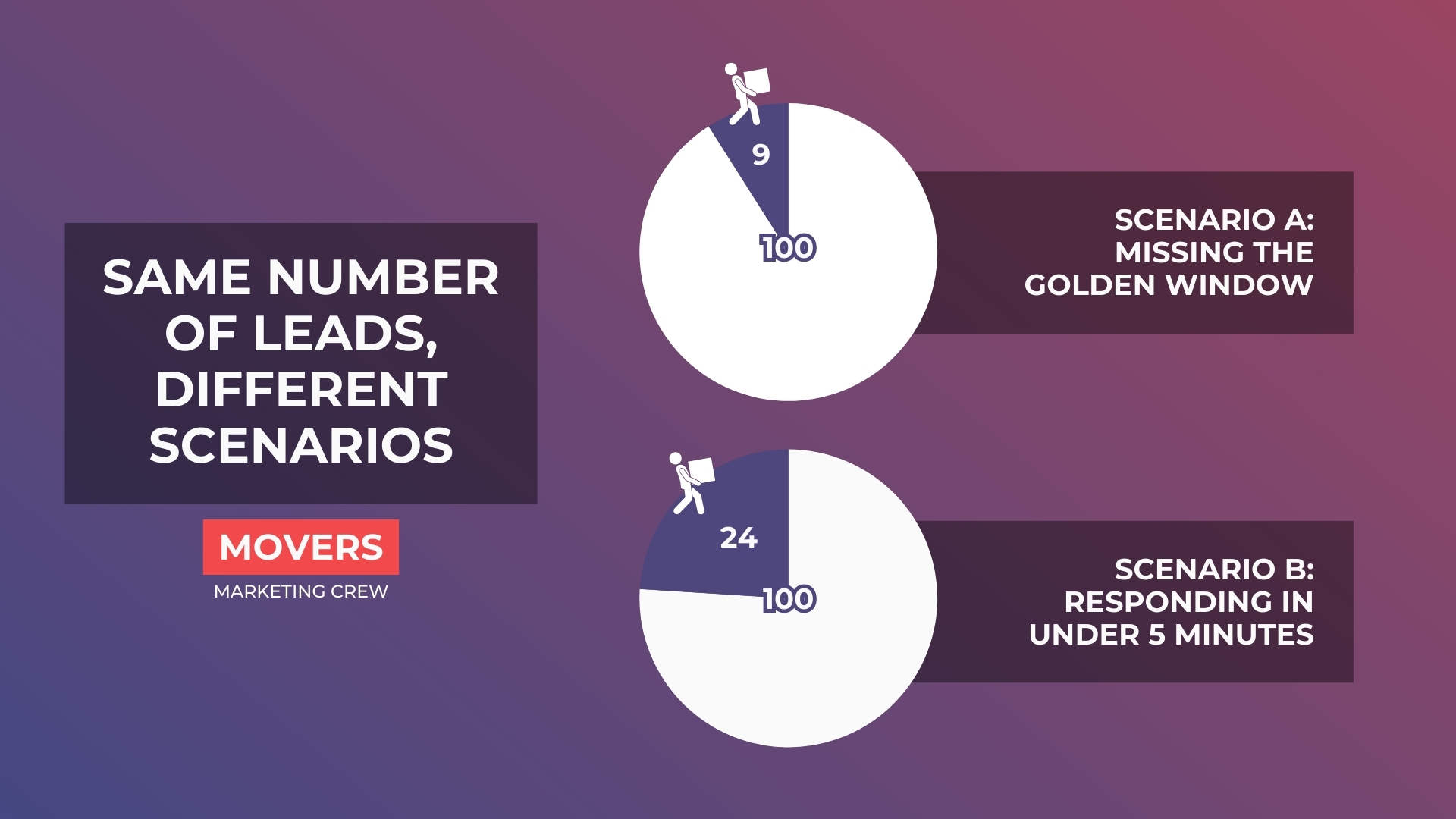
Let’s take a closer look at the financial impact of missed opportunities. Let’s say you receive 100 leads in one month. Here is how that plays out in two very different scenarios.
Scenario A: You miss the “Golden Window”
In this scenario, you don’t respond within the first 5 minutes. Because of the delay, you only manage to contact 30% of those leads. Even if you have a solid sales script and close 30% of those people you actually speak to, that results in only 9 booked jobs. After deducting the costs, you are barely generating enough revenue to cover your costs.
Scenario B: You respond in under 5 minutes
You call immediately, and because you catch them while they are still looking at their screen, your contact rate jumps to at least 80%. With the exact same 30% closing rate, you now book 24 jobs. Think about the difference. You just booked 15 more moves from the exact same number of leads, simply by picking up the phone faster. Now this profit can immediately be reinvested into more aggressive marketing or into better equipment.
Automation Is Your Best Crew Member
By now, you are probably thinking: “I’m constantly moving and running my business. I can’t possibly answer the phone in less than 5 minutes every single time.” And you are absolutely right. You can’t. But you can take the advantage of modern technology.
Automated SMS
Most customers who fill out a quote form on your website are also filling out forms on a few other competitor sites immediately after. Your goal isn’t just to say hello, it is to interrupt that pattern and stop them from contacting the next mover. Automation shouldn’t sound like a robot, it should sound like a bridge to a human conversation. Use the automated text to buy yourself the 5-10 minutes you need to get off the truck or finish a task.
After Hours Auto Responders
The reality of the moving industry is that your customers are busy at the same time you are working. They research moving companies when they are off work, which is also the time when you are usually unavailable for business. If a lead contacts you at 9 PM and gets silence, they will assume you are unresponsive and keep searching until someone answers. Statistics show that roughly 85% of people whose calls are not answered will not call back. An auto-responder is a lead retention tool. It lets them know their request has been received and that they will be contacted first thing in the morning.
Conclusion
The difference between a struggling moving company and local area leader isn’t dependent only on the quality of their trucks or the size of their crew. The speed of their follow-up plays a great role in acquiring new customers. In the digital world, not answering promptly is interpreted as a lack of professionalism, which instantly decreases your chances of closing the job.
You don’t necessarily need a bigger ad budget to grow your business this year. You just need to stop letting the leads you already paid for slip through your fingers. Whether you commit to answer the phone instantly, or set up automation to do it for you, the goal remains the same: build trust immediately and stop giving your competitors a head start.