
For movers, standing out online is crucial for attracting new clients. While many elements contribute to online success, On-Page SEO is the foundational factor that helps your website communicate directly to search engines, and more importantly, to your potential customers. This guide is designed specifically for movers, breaking down the complexities into actionable steps that will significantly improve your visibility, attract more qualified leads, and grow your business.
Understanding On-Page SEO: The Foundation of Online Visibility
Before we dive into the optimizing your website, let’s first clarify what exactly On-Page SEO means. On-Page SEO refers to all the optimization efforts you make directly on your website. It’s about making your website easy to navigate, choosing the right keywords for your moving services, and structuring your content in such a way that both customers and search engines can easily understand what your moving business is all about.
The goal of optimizing your On-Page SEO is simple: increase click-through rate (CTR) and organic traffic. The more relevant your content is to what people a re searching for, the higher your chances of ranking well. Think of it as make your physical storefront as appealing as possible. Only here, we are talking about website – your online storefront that works 24/7.
Crafting Quality Content: More Than Just Words
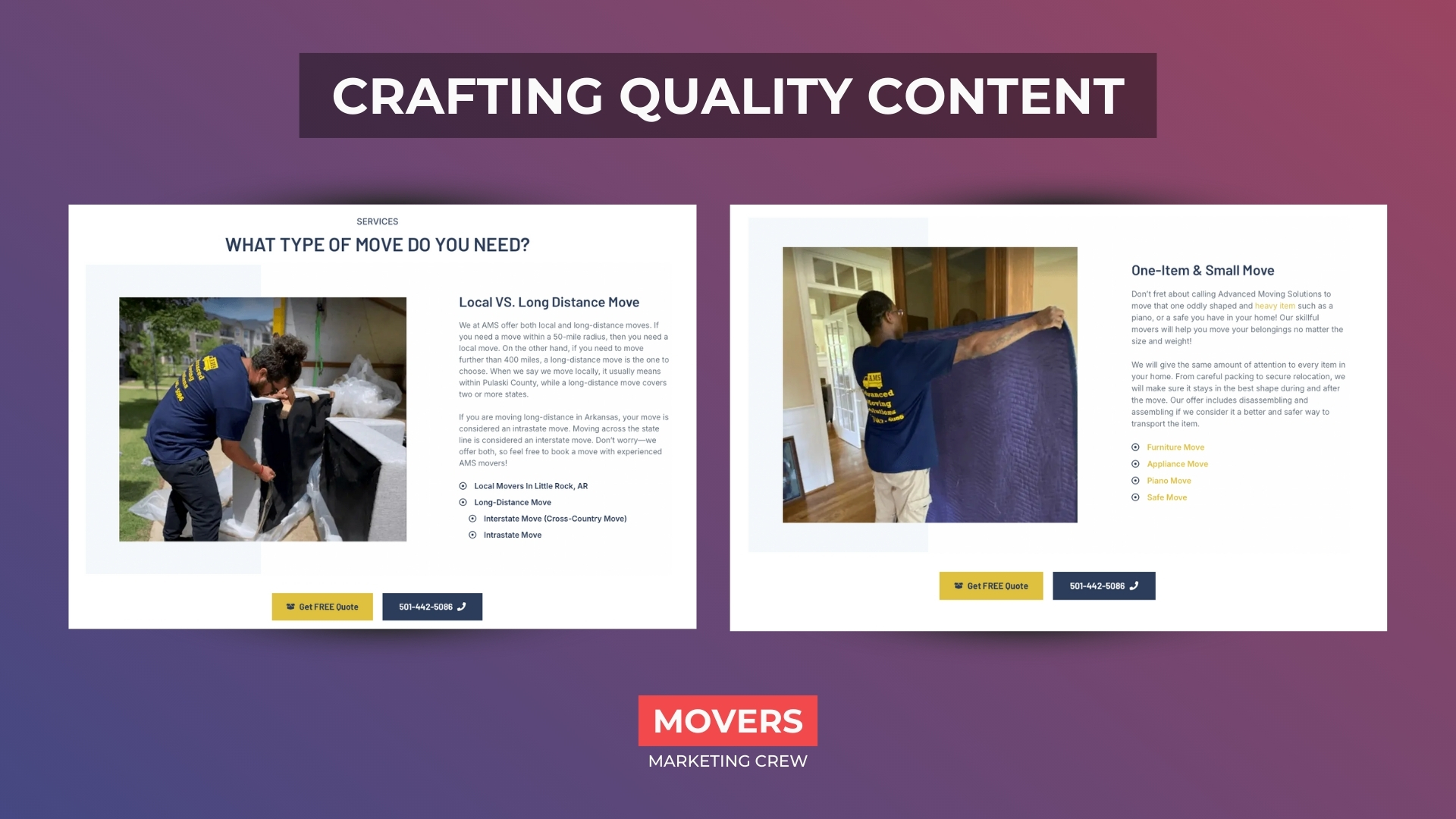
Search engines always prioritize quality content that genuinely helps users. For a moving company, this means doing more that just listing your services. It means creating informative content that addresses the specific needs and answers most of the questions your potential clients might have.
Your website visitors likely have specific inquiries about costs, type of move, insurance or maybe they need to move a special item, such as piano. Your website should anticipate, and thoroughly answer these questions. For instance, instead of a simple service page for “long-distance moving”, consider creating a comprehensive guide that explains what to expect during a long-distance move, a breakdown of potential costs, information on insurance options and an FAQs specific to long-distance moves.
This approach demonstrates your expertise and builds trust with visitors, who are more likely to perceive your company as reliable and professionals. Needless to say, if it’s great for potential customers, it’s even better for SEO, as search engines reward websites that provide genuine value.
Understanding User Intent
To make the content truly effective, you must understand user intent. This means recognizing the goal of the person searching for a specific term and providing the solution they need. Not every visitor is ready to book immediately, and your content should reflect where they are in the buying cycle.
Early Stage
If someone searches for “best ways to move”, they are researching their options and are at the beginning of the buying process. They might need to move, but the actual date might be weeks or months away. Their problem is a lack of information. The goal here is to provide as many moving options as possible, with pros and cons for each of them.
Final Stage
When someone searches for “movers near me”, the chances are that they have already decided to hire professionals and are ready to book. Their problem is finding a trustworthy moving company. To satisfy this user, you need to showcase your company’s value: highlighting that you are fast, reliable and safe, backed by 5-star reviews and competitive pricing. This approach builds trust with visitors, as you are communicating with each one of them, no matter at what buying stage they currently are.
Structuring for Success: H1, H2, H3 Tags & Permalinks
H1 Tags
H1 is your main title on the page, which tells users (and search engines) what the page is all about. For example, if you are creating a page dedicated to local moving in your area, H1 tag could be, for example: Local Movers In Little Rock, AR. H1 tag should include your primary keyword and you should only use one H1 tag per page
H2 and H3 tags
H2 tags should be used for major sections within your content. They should include relevant keywords that summarize the section below. For example: “Full-Service Apartment Move”. H3 tags are used for subsections within H2 section, further breaking down your content. A structure like this helps search engines index your pages more effectively.
Permalinks
Your page URLs, or permalinks, are another crucial on-page element. They should be concise, descriptive, and include relevant keywords. Instead of a generic URL like “/page 214”, aim for something like “/miami-local-movers”. Links like these are easier for users to understand and remember, provide another strong signal to search engines, and generally look better when shared on social media or other type of digital communication.
Enhancing User Experience: Page Title & Meta Descriptions
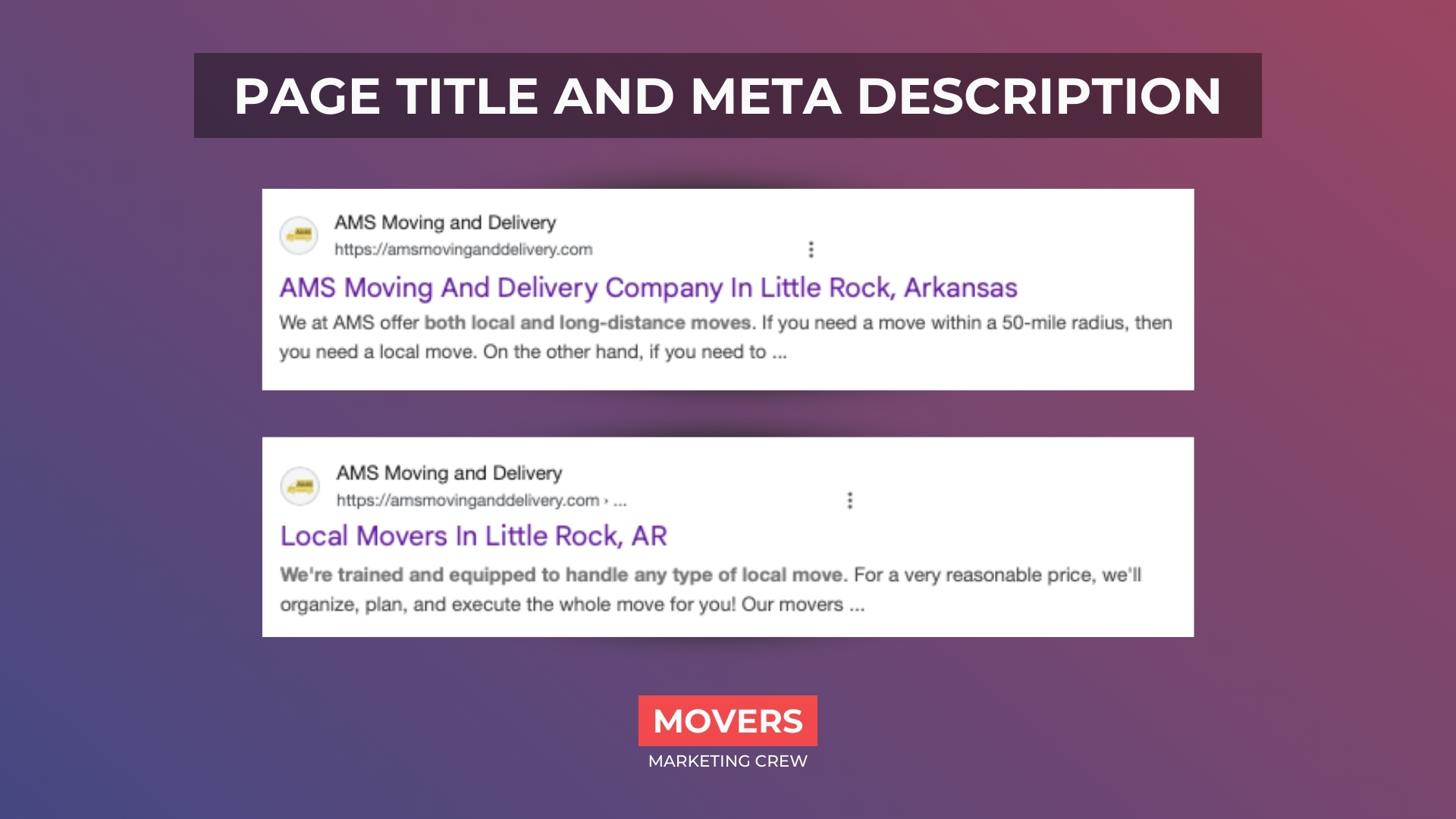
Page title and meta description is the short snippet users see when browsing through the search page. It is a unique opportunity to grab someone’s attention and get them to visit your website. For a maximum impact, always place your main keywords at the beginning of your. For example, if you want to rank for “local movers”, set a page title to “Local movers in Miami, Florida”.
Meta description is a brief description that’s located beneath the page title in the search results. It’s incredibly important for your click-through-rate, as it may be a deciding factor for a user to visit your page.
Optimizing images for SEO
Whenever you are adding images to your site, have in mind the size, as large image files can take a lot of time to load, and greatly affect the user experience, which gets recognized by search engines and you damage your rankings. Tools like TinyPNG or other image compressors can help. Use modern image formats like WebP or JPEG for photographs, and PNG for graphics.
One common mistake is uploading an image that is much larger than the space it occupies on the website. For example, if your website displays an image at a width of 600px, but you upload a file that is 1200px wide, the browser still has to load the full size and then shrink it down. This adds unnecessary weight to your page and slows down your lo
Another thing to have in mind when optimizing images for your website is the file name. Be descriptive and use keywords, showing what the image is all about, for example “miami-local-movers-truck.jpg”, instead of “IMG_142.jpg”. Alt text should also be filled, as it is crucial for accessibility (screen readers use it), but also for SEO. Include relevant keywords in the alt text, for example: “Professional long-distance movers loading furniture into a truck”.
Properly optimized images enhance your website content, improve accessibility, and contribute to faster page loading, all of which benefit your On-Page SEO.
Building Connections: Internal & External Links
Internal Links
Links within your website help users navigate your website more easily, discovering more of your content as they scroll through your pages. On the other hand, they are helping search engines understand the relationships between the pages on your website, and which pages are the most important. By guiding users to relevant content, you are keeping them on your website longer, which signals to search engines that your site is valuable.
External Links
If you are using external links, be sure that they are connected to authoritative sources, such as reputable packing material suppliers, or local chamber of commerce. They can provide additional valuable information you your users. Always ensure that any external links open in a new tab to keep users on your website.
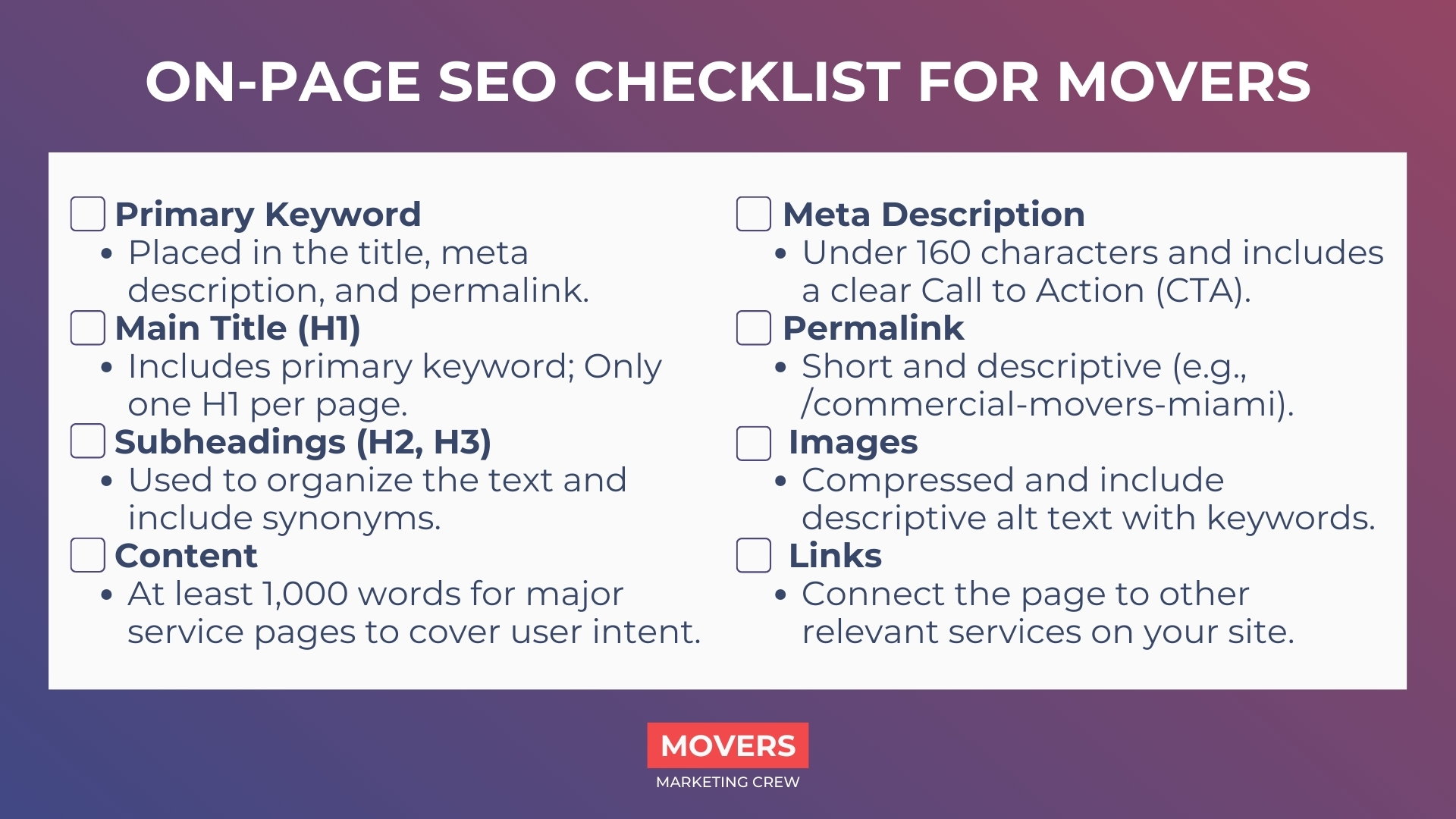
On-Page SEO Checklist for Movers:
Ready to start improving your website? Here is a quick checklist that you can apply to each of your pages.
Conclusion
Implementing the On-Page SEO strategy is not a one-time task, but an ongoing process that needs constant surveillance. For movers, this goes far beyond than just appearing higher in search results. It means connecting with customers precisely when they need your service most. By consistently creating high-quality, structured and optimized content, you will provide an exceptional experience for your potential clients. Have in mind everything we went through in this article, optimize your website accordingly, and watch as your organic visits rise.